
Wiping human skin, cleaning medical devices, or wiping tables, chairs and door handles in public places may appear to differ only in the object being wiped. In the EU, however, these uses can fall under different regulatory requirements. Even use in a hospital does not automatically make a product a medical device.
Product classification depends on the intended purpose, the object of use, the mode of action, and the claims made on packaging, instructions and promotional materials. Dividing suppliers into those “with CE” and those “without CE” before establishing the intended use can send procurement in the wrong direction from the outset.
CE is not a universally applicable “EU quality certification.” Article 30 of Regulation (EC) No 765/2008 explicitly states that the mark may be used only on products for which relevant EU harmonisation legislation requires it.[1]
A wipe regulated as a cosmetic or under the Biocidal Products Regulation (BPR) should therefore not itself bear a CE mark unless it has a dual purpose that brings it within CE-marking legislation. A CE mark does not, by itself, establish compliance. Printing one on packaging when the product is outside the scope of CE-marking requirements is itself a breach of the rules.
An anonymised real procurement case
VINNER Health’s business development team once worked on a European elderly-care procurement project for rinse-free bathing wipes. The procurement department listed them as “medical consumables.” Their reasoning was understandable: the wipes were intended for bedridden older adults in a professional care facility, so they assumed they should be purchased as medical devices and requested CE marking.
The actual intended purpose, however, was simply to cleanse the body, remove dirt and body odour, and provide routine care for intact skin. The wipes were not intended to diagnose or treat disease, to be used on broken skin, or to disinfect medical devices, so they did not fall into the medical-device category. Nor were they intended to disinfect human skin, ruling out the biocidal-product category in this case. Under Regulation (EC) No 1223/2009, substances or mixtures intended mainly to clean external parts of the human body, protect the skin, keep it in good condition, or correct body odours fall within the scope of cosmetics legislation.[2]
Likewise, bathing wipes used by healthy people and by ICU patients do not become medical devices merely because the user is in a hospital bed, if their intended purpose remains the cleansing and care of intact skin.
Three common product categories
For the cleansing, care and disinfectant wipes discussed in this article, three categories provide a useful starting point:
- Cosmetics: body cleansing and routine skin care. Common examples include baby wipes, pure-water wipes, cooling wipes and bathing wipes.
- Medical devices: products specifically intended to clean or disinfect medical devices. Examples include surface-disinfection wipes intended specifically for medical devices.
- Biocidal products: general human-hygiene disinfection and environmental surface disinfection. Examples include skin-disinfection wipes and surface-disinfectant wipes.
Note: these are common primary product classifications, not an exhaustive account of every borderline case. Products entering the EU may also be subject to packaging, chemicals, environmental, labelling and waste requirements.
Category 1: cosmetics — body cleansing and routine care
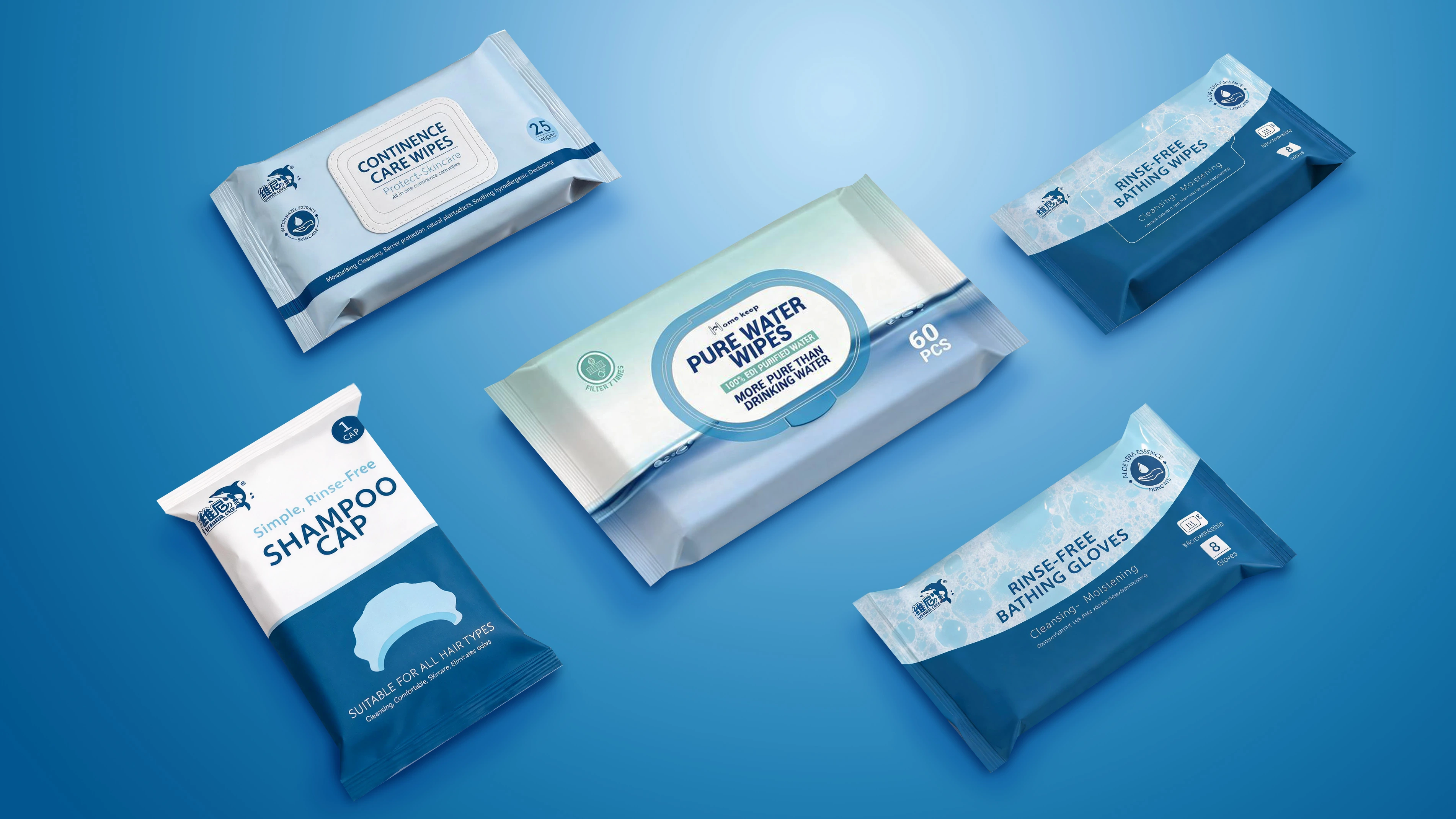
Baby wipes, rinse-free bathing wipes, bathing gloves, rinse-free shampoo caps and ordinary body-cleansing wipes often fall within the cosmetics category and are regulated by Regulation (EC) No 1223/2009, the EU Cosmetics Regulation.[2] Their common feature is that their main purpose is to clean external parts of the human body, protect the skin, or keep it in good condition.
CE marking is not applicable when purchasing these products, because cosmetics are not a product category covered by CE marking. Cosmetics typically require the following compliance documentation:
1. CPSR: does the safety assessment cover the actual product?
CPSR stands for Cosmetic Product Safety Report. Before a product is placed on the market, an appropriately qualified safety assessor must complete the assessment required by the legislation.[2][4]
A formulation sheet alone is not sufficient. The assessment must also consider the qualitative and quantitative composition, physicochemical properties, stability, microbiological quality, toxicological information on raw materials, exposure to the product and its ingredients, and relevant preservative challenge-test data, where applicable.
The legislation does not specify a minimum page count for a CPSR. Rather than comparing report thickness, buyers should check whether it corresponds to the formulation currently being sold, the method of use and the target population, and whether sufficient evidence supports its conclusions.
2. PIF: is the product file complete and maintained?
The Product Information File (PIF) contains the product description, CPSR, manufacturing method, a statement of GMP compliance, claims-supporting evidence and other relevant information.
The legislation requires the PIF to be retained for 10 years after the last batch of the product has been placed on the market.[2][4]
3. CPNP: notification does not mean product approval
Before a cosmetic product is placed on the EU market, notification through the Cosmetic Product Notification Portal (CPNP) must be completed.[5]
CPNP is a notification system, not a product-approval process. Completing notification does not result in the EU issuing a “CPNP Certificate.”
Suppliers can provide notification information for procurement verification, but a notification screenshot must not be presented as proof of EU product approval.
4. EU Responsible Person and GMP
A cosmetic product entering the EU market must have a Responsible Person established in the EU who assumes the responsibilities specified in the legislation.[2]
Manufacturing must comply with GMP. EN ISO 22716 is a commonly used industry reference, but the legal requirement is GMP compliance; the legislation does not require every factory to obtain a third-party ISO 22716 certificate.[6][7]
A certificate can assist procurement review, but records and supporting evidence are still needed to demonstrate that the factory actually manufactures in accordance with the relevant requirements.
Category 2: medical devices — physical cleaning or disinfection specifically of medical devices
Products classified as medical devices require CE marking.
1. Medical-device cleaning wipes: MDR Class I
Medical-device disinfectants must be considered under the Medical Devices Regulation (MDR), a framework familiar to many buyers. What is often overlooked is that products specifically intended to clean medical devices are also within the MDR’s scope.[8]
For example, a cleaning wipe intended to remove dirt, dust or residues from medical devices, acting only through physical cleaning and without a disinfecting action, can generally be classified as Class I under Rule 1 where no more specific rule applies. Products specifically intended for cleaning contact lenses are excluded from this example.[8][9]
These Class I products still require CE marking. Ordinary Class I devices, however, typically do not have a CE certificate issued by a notified body. Under MDR Article 52(7), once the manufacturer has completed the relevant technical documentation and conformity-assessment requirements, it can sign an EU Declaration of Conformity (DoC) and affix the CE mark. Special Class I cases, such as sterile devices, devices with a measuring function and reusable surgical instruments, involve a notified body within the relevant scope.[8]
Making a “Notified Body CE Certificate” mandatory when purchasing ordinary Class I device-cleaning wipes may therefore exclude products that otherwise meet the applicable requirements.
2. Medical-device disinfectant wipes: MDR Class IIa / IIb
Wipes specifically intended to disinfect medical devices are classified under Rule 16 of MDR Annex VIII.[8][9] The general rule assigns products specifically intended for disinfecting or sterilising medical devices to Class IIa. Class IIb must be considered where a disinfectant is specifically intended for invasive medical devices and that disinfection is the endpoint of the device-processing procedure.[8][9]
For example, an alcohol wipe intended for preliminary surface disinfection of medical devices, rather than terminal disinfection, can generally be classified as a Class IIa medical device under Rule 16. A steam-disinfection device intended for final disinfection of medical devices is classified as Class IIb under Rule 16.
Category 3: biocidal products — general human-hygiene and public-environment disinfection
Where a wipe’s main purpose is human-hygiene disinfection or disinfection of general environmental surfaces in public places, it is regulated by Regulation (EU) No 528/2012, the Biocidal Products Regulation (BPR).[17] Products regulated under the BPR do not require CE marking on that basis alone.
The BPR defines 22 product types (PTs). Wipes regulated under the BPR commonly fall within PT1 or PT2.
1. PT1: human hygiene
Ordinary hand-disinfection wipes are a common PT1 example. Their primary purpose is disinfection, distinguishing them from ordinary skin-cleansing wipes. Wound disinfection, pre-operative or pre-injection skin disinfection, and medicinal claims may instead bring a product within medicinal-product legislation; these uses cannot all be treated as BPR PT1.[18]
2. PT2: disinfectants and algaecides not intended for direct application to humans or animals
Wipes used in offices, schools, stations, shopping centres and other public places to disinfect ordinary tables, chairs, door handles, walls, floors and similar general environmental surfaces are usually considered under BPR PT2.[17]
BPR procurement: verify the product’s authorisation and scope of use
The BPR regulates both active substances and finished products. Approval of an active substance does not automatically grant market access to every wipe containing it.[19]
Buyers should verify the product’s authorisation in the target country and check its authorised uses, target microorganisms, instructions for use and contact times. Efficacy conclusions in test reports should also correspond to the product actually sold and its labelling requirements.
If the same wipe claims both “Disinfects Medical Devices” and disinfection of ordinary desks and door handles, the two uses must be assessed separately. Medical-device disinfection may fall under the MDR, while general environmental surface disinfection may fall under the BPR. Article 2(2) of the BPR addresses this regulatory interface: MDR CE marking cannot automatically cover an additional PT2 use claimed for the product.[17] Such dual-purpose products therefore need both BPR compliance and MDR CE marking.
Wet-wipe regulatory classification checklist
For your procurement team’s convenience, we have summarised the article in the table below. We recommend downloading and keeping it for reference:
| Intended use | Primary regulatory framework | Common classification | Procurement priorities | CE marking |
|---|---|---|---|---|
| Body cleansing, rinse-free bathing, hair cleansing and routine care of intact skin | Cosmetics Regulation | Cosmetic | CPSR, PIF, CPNP, EU Responsible Person, ISO 22716, etc. | Not applicable |
| Physical cleaning specifically of medical devices, excluding contact-lens products | MDR | MDR Class I | Classification rationale, technical documentation, DoC, performance evidence, ISO 13485, etc. | Required; ordinary Class I typically has no notified-body certificate |
| Disinfection of non-invasive medical devices | MDR Rule 16 | MDR Class IIa | Notified-body certificate, DoC, disinfectant-efficacy test reports, ISO 13485, etc. | Required |
| Disinfection at the endpoint of processing invasive medical devices | MDR Rule 16 | MDR Class IIb | As above; also verify the specific intended use and processing procedure | Required |
| General human-hygiene disinfection, e.g. ordinary hand disinfection | BPR | BPR PT1 | Target-market authorisation, authorised uses, efficacy and safety evidence | Not required by the BPR itself |
| Disinfection of general environmental surfaces in public places | BPR | BPR PT2 | As above | Not required by the BPR itself |
Conclusion
Before sending the next RFQ, buyers should clarify the product category based on its intended use.
A supplier familiar with European legislation should be able to explain why a particular regulatory route applies and then provide the corresponding evidence. If a supplier can only repeat “we have certificates” without explaining which products and uses those certificates cover, the procurement review is not yet complete.
An incorrect product classification can mean redoing tests, labels, packaging and technical documentation. Clearly defining the intended use before discussing the required documents usually makes the project run more smoothly.
If you are planning to source wet wipes for the European market, please contact VINNER’s business development team. We can help map out your product’s compliance route and propose a solution to keep the project moving smoothly.
References
- [1] EUROPEAN PARLIAMENT, COUNCIL OF THE EUROPEAN UNION. Regulation (EC) No 765/2008[S]. Official Journal of the European Union, 2008, L218: 30–47. Article 30.
- [2] EUROPEAN PARLIAMENT, COUNCIL OF THE EUROPEAN UNION. Regulation (EC) No 1223/2009 of 30 November 2009 on cosmetic products[S]. Official Journal of the European Union, 2009, L342: 59–209. Consolidated version: 18 May 2026.
- [3] WORKING GROUP ON COSMETIC PRODUCTS, SUB-GROUP ON BORDERLINE PRODUCTS. Manual on the Scope of Application of the Cosmetics Regulation (EC) No 1223/2009 (Art. 2(1)(a)), Version 5.5[EB/OL]. June 2025. Section 1.6: Wipes. Non-binding guidance.
- [4] EUROPEAN COMMISSION. Commission Implementing Decision 2013/674/EU of 25 November 2013 on Guidelines on Annex I to Regulation (EC) No 1223/2009 on cosmetic products[S]. Official Journal of the European Union, 2013, L315: 82–104.
- [5] EUROPEAN COMMISSION. Cosmetic product notification portal[EB/OL]. [2026-10-19].
- [6] INTERNATIONAL ORGANIZATION FOR STANDARDIZATION. ISO 22716:2007 Cosmetics—Good Manufacturing Practices (GMP)—Guidelines on Good Manufacturing Practices[S]. Geneva: ISO, 2007. Reviewed and confirmed in 2022.
- [7] EUROPEAN COMMISSION. Commission communication in the framework of the implementation of Regulation (EC) No 1223/2009—Publication of titles and references of harmonised standards (2011/C 123/04)[S]. Official Journal of the European Union, 2011, C123: 3.
- [8] EUROPEAN PARLIAMENT, COUNCIL OF THE EUROPEAN UNION. Regulation (EU) 2017/745 of 5 April 2017 on medical devices[S]. Official Journal of the European Union, 2017, L117: 1–175. Consolidated version: 19 July 2026.
- [9] MEDICAL DEVICE COORDINATION GROUP. MDCG 2021-24 Rev.1: Guidance on Classification of Medical Devices[EB/OL]. April 2026. Non-binding guidance.
- [10] EUROPEAN COMMITTEE FOR STANDARDIZATION. EN 14885:2022 Chemical disinfectants and antiseptics—Application of European Standards for chemical disinfectants and antiseptics[S]. Brussels: CEN, 2022. Including corrigendum AC:2023.
- [11] EUROPEAN COMMITTEE FOR STANDARDIZATION. EN 13727:2012+A2:2015 Chemical disinfectants and antiseptics—Quantitative suspension test for the evaluation of bactericidal activity in the medical area—Test method and requirements (phase 2, step 1)[S]. Brussels: CEN, 2015.
- [12] EUROPEAN COMMITTEE FOR STANDARDIZATION. EN 13624:2021 Chemical disinfectants and antiseptics—Quantitative suspension test for the evaluation of fungicidal or yeasticidal activity in the medical area—Test method and requirements (phase 2, step 1)[S]. Brussels: CEN, 2021.
- [13] EUROPEAN COMMITTEE FOR STANDARDIZATION. EN 14476:2025 Chemical disinfectants and antiseptics—Quantitative suspension test for the evaluation of virucidal activity in the medical area—Test method and requirements (Phase 2/Step 1)[S]. Brussels: CEN, 2025.
- [14] EUROPEAN COMMITTEE FOR STANDARDIZATION. EN 16615:2026 Chemical disinfectants and antiseptics—Quantitative test method for the evaluation of bactericidal and yeasticidal and/or fungicidal and/or tuberculocidal and/or mycobactericidal activity on non-porous surfaces with mechanical action employing wipes or mops in the medical area (4-field test)—Test method and requirements (phase 2, step 2)[S]. Brussels: CEN, 2026.
- [15] MEDICAL DEVICE COORDINATION GROUP. MDCG 2022-5 Rev.1: Guidance on Borderline between Medical Devices and Medicinal Products under Regulation (EU) 2017/745 on Medical Devices[EB/OL]. October 2024. Non-binding guidance.
- [16] EUROPEAN COMMISSION. Updated list of notified bodies’ standard fees[EB/OL]. 13 July 2026.
- [17] EUROPEAN PARLIAMENT, COUNCIL OF THE EUROPEAN UNION. Regulation (EU) No 528/2012 of 22 May 2012 concerning the making available on the market and use of biocidal products[S]. Official Journal of the European Union, 2012, L167: 1–123. Article 2(2), Annex V.
- [18] EUROPEAN CHEMICALS AGENCY. Guidance on the Biocidal Products Regulation, Volume II: Efficacy, Parts B+C: Assessment and Evaluation, Version 6.0[EB/OL]. August 2023. Section 5.4.1.1.
- [19] EUROPEAN CHEMICALS AGENCY. Biocides supplier or user[EB/OL]. [2026-10-19].
- [20] EUROPEAN COMMISSION. Commission Implementing Regulation (EU) 2025/1490 of 24 July 2025 amending Implementing Regulation (EU) No 564/2013 as regards the adaptation of fees to inflation[S]. Official Journal of the European Union, 2025, L, 2025/1490.